


SaaS and on-premise: what is the difference
When your organization is ready for new business software, one of the first questions is often whether to opt for an on-premise or SaaS solution. Nowadays, cloud-based SaaS solutions are outperforming on-premises software in popularity. But is a SaaS solution the best choice for your organization? And what exactly is the difference between on-premise and SaaS? We would be happy to explain.
1. Use of the server
One of the most important differences between on-premise and SaaS is which server you use for the software. On-premise literally means “on location”. If your company chooses an on-premises package, the software is installed on your own server. Because the software resides on your own server, your company is responsible for security, management, and availability. In practice, this means you need your own IT department, although the software vendor usually continues to offer maintenance services after implementation. If you choose a SaaS solution, such as our service and maintenance software, things work slightly differently. The solution is no longer installed on your own server but is hosted on the vendor’s cloud server. This automatically means that the vendor of your SaaS package is responsible for security, availability, and management. Generally, you no longer need your own IT department for this.
2. On-premise and SaaS price difference
Another difference between on-premise and SaaS is the pricing structure. If you choose on-premises software, you purchase a license on a one-off basis. Subsequently, however, you pay periodically for service and maintenance. This is usually a fixed percentage of the license fee. Therefore, you make a significant investment in an on-premises package, which generally entails greater risk. With a SaaS solution, you pay monthly for software access on a subscription basis. Service and maintenance are already included in this price, so you do not have to make a large, one-off investment. Incidentally, the difference in pricing structure does not mean that one of the two is more expensive than the other after several years.
3. Availability at the office, on the road, and at home
As mentioned earlier, on-premise software is installed on your own server. This also means the software can only be accessed on office computers. Your employees often do not have access to the system at home. With SaaS, things work a little differently. A SaaS solution resides in the cloud, allowing you to access the system anytime, anywhere, on any device. Your employees work uniformly at the office, on the go, and at home.
4. The differences in scalability
On-premise and SaaS also differ in scalability. Generally, it is somewhat more difficult to expand or modify an on-premise package. If you choose to do so anyway, it often has consequences for your hardware. For example, you may need to purchase and configure new servers. A SaaS solution, on the other hand, is relatively easy to expand or modify. You can easily add or deactivate features. Additionally, you can easily scale the number of employees using the system up or down. You never pay for something you do not use.
Difference between on-premise, IaaS, PaaS, and SaaS
In addition to the on-premise and SaaS options, you can also choose IaaS and PaaS. The first thing that stands out is that—except on-premise—they all end in aaS, which stands for “as-a-Service.” As a user, you therefore pay for the service or solution you need. If you choose IaaS—Infrastructure-as-a-Service—it means that you purchase the infrastructure on which the services run from an external provider. You pay for empty server space and are responsible for configuring and maintaining this environment yourself. Naturally, the costs of IaaS are lower than those of SaaS, but you do need technical knowledge to set up and maintain the server.
If you choose PaaS, the external provider takes care of the server setup, including the Operating System and middleware. With a PaaS solution, you outsource the hosting and only need to focus on the software on the platform. PaaS is particularly interesting if you lack the knowledge to maintain the infrastructure, but it can be a disadvantage that the software and middleware used are determined for you. To clearly explain all the differences between on-premise, IaaS, PaaS, and SaaS, we have created the table below for you.
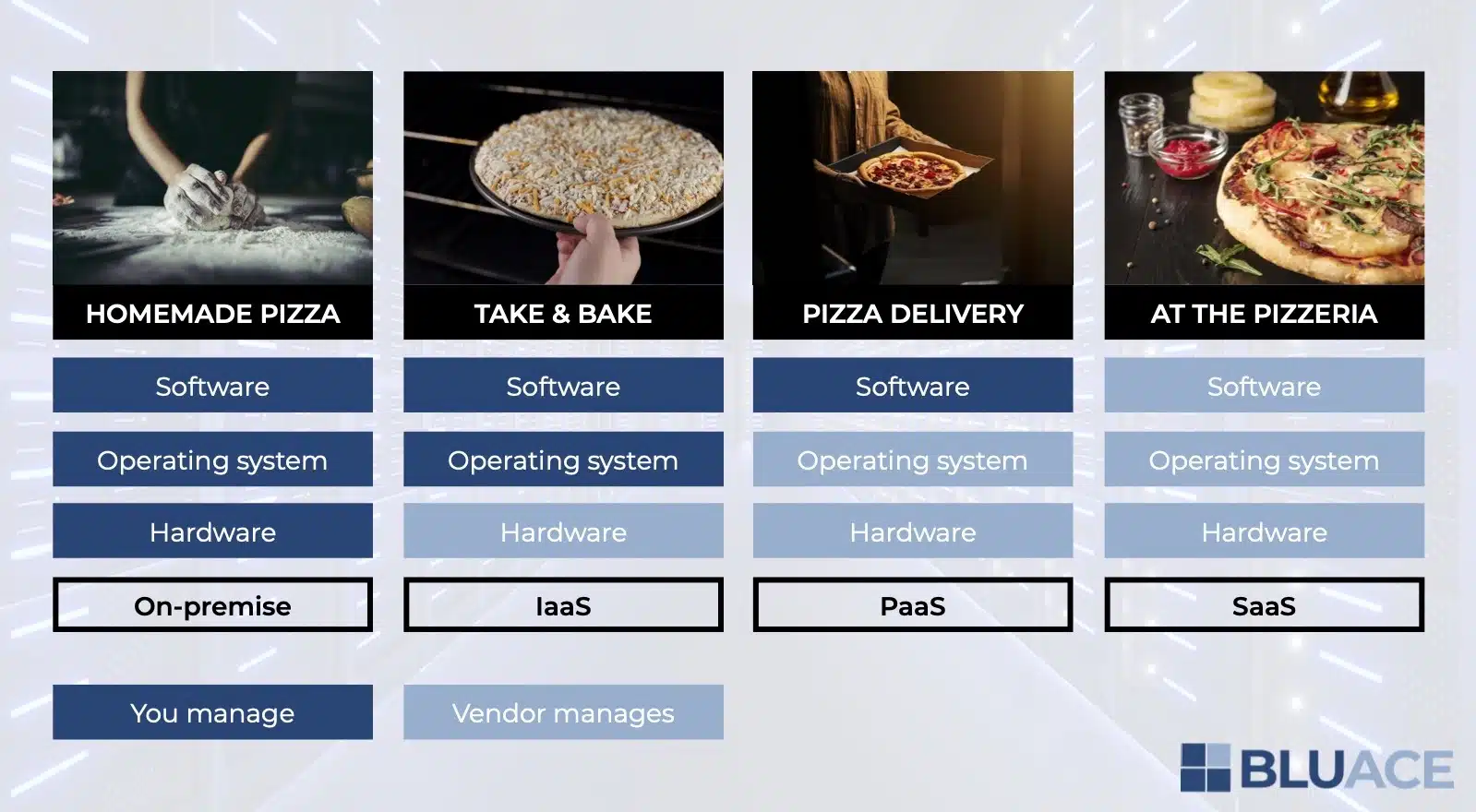
Interested in a SaaS solution for your organization?
Our team is happy to assist you.
Linde van der Velde
+31858200802
info@bluace.nl