

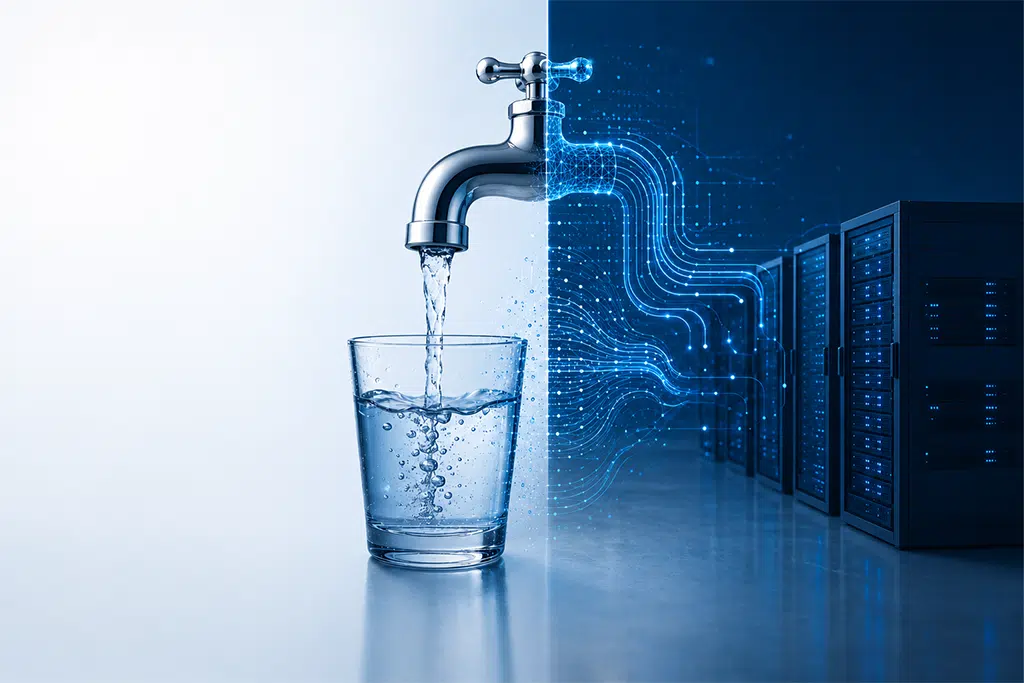
IT works just like tap water, until it doesn’t anymore
Nowadays, IT is taken for granted as much as tap water. It just works until suddenly it stops. And it is precisely then that it becomes clear how much actually lies behind that self-evidence.
Behind both water and IT lies an invisible world of infrastructure, processes, controls, and people who ensure that everything continues to function.
The infrastructure that you do not see, but do use
When you turn on the tap, you expect clean and safe water. You don’t think about it any further. Yet that water is the result of an extensive system of purification, transport, monitoring, and maintenance.
IT works exactly the same way. We use software, cloud environments, and digital services daily without pausing to consider the networks, servers, integrations, and security layers that make it all possible.
That complexity only becomes visible the moment something fails.
Keep it pure: water and data follow the same logic.
Water must be purified before it is suitable for use. Contaminants are removed, and quality is continuously monitored.
The same principle applies in IT. Systems must be maintained, software must be updated, and security must be actively managed. This is IT management in practice: ensuring that the digital environment remains clean, safe, and reliable.
Without that continuous maintenance, pollution occurs, sometimes visible, but often silent and under the radar.
What happens when “pollution” accumulates?
With water, the impact of pollution is immediately clear: it affects health and the living environment.
In IT, this is less visible, but at least as harmful. Data pollution can arise from outdated information, incorrect input, poor integrations, or security issues.
The consequences are often organizational in nature: incorrect reports, inefficient processes, and decisions based on unreliable data.
Quality is no coincidence.
Clean water is the result of strict processes and clear responsibilities. The same applies to reliable IT environments.
This means that everyone who works with data or systems influences the quality of those data or systems. Not only IT teams, but the entire organization.
This requires clear agreements and discipline at the foundation:
- Consistent data entry and management
- Structural attention to data quality
- Well-configured access security
- Up-to-date and maintained systems
- Clear documentation and metadata
- Insight into the data lifecycle
- Regular checks and audits
Standardization as the foundation for reliability
At Bluace, we believe in innovation through standardization. Not by adding complexity, but rather by working with proven structures and repeatable processes.
Just as water purification is only reliable thanks to standardized steps, the same applies to IT systems. Standardization ensures predictability, security, and scalability.
And that is precisely the basis for true innovation.
IT and water may seem like completely different worlds, but the similarity is clear: both are essential, invisible systems that only function properly if they are continuously managed, monitored, and improved.
And precisely because they seem so self-evident, they deserve sustained attention.
Do you want your IT environment to work just as reliably, cleanly, and naturally as tap water?
Shiwan Roepa
085 – 8200802
info@bluace.nl